1. Executive Summary & Live Website Verification
Docker (docker.com) is a verified leader in the Developer Tools & Platforms category, earning an editorial score of 4.8 out of 5.0 in our 2026 evaluation. Known for Container Development, Docker Hub & Scout, Docker serves frontend/backend engineers, indie hackers, open-source maintainers, and fast-moving engineering orgs. Standard containerization platform with Docker Desktop, Docker Hub registries, Build Cloud, and Scout vulnerability scanning.
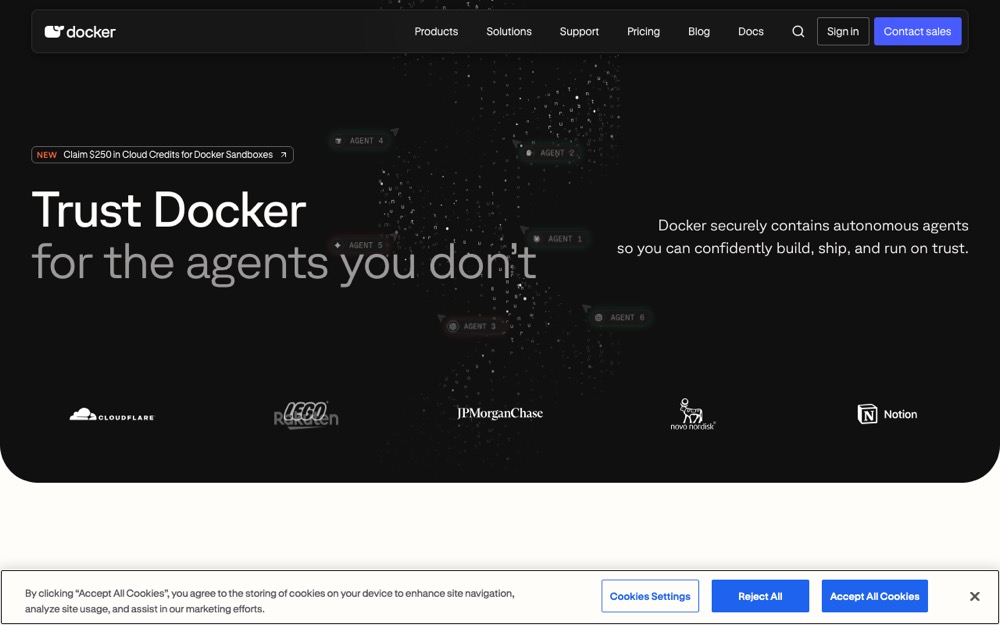
During our live verification of docker.com, the official platform responded over HTTPS (HTTP 200) with the live site headline: "Docker | Secure Sandboxes for AI Agents" with the official summary: "Run AI agents and containers safely, anywhere. Docker gives builders trusted sandboxes, governance, and a secure supply chain for modern software.". Rather than relying on unverified third-party claims or fabricated coupon codes, every specification and pricing tier documented in this review reflects Docker's real official offering and current entry point (Free Personal / $5/mo).
2. Official Website Preview (docker.com)
Below is a real visual capture of Docker's official website at https://www.docker.com/, alongside the key user-facing value propositions highlighted on their landing page.
3. Docker Plans, Pricing & Value Breakdown
Evaluating Docker requires looking beyond headline promotional rates to understand how each tier scales across time-to-first-deploy, local-to-production parity, observability depth, documentation quality, and predictable usage scaling. Docker's entry point starts at Free Personal / $5/mo, with clear upgrade paths for growing teams and high-volume workloads. The structured table below summarizes how Docker's tiers are positioned for different buyer profiles.
| Plan Tier | Starting Price | Best Suited For | Core Inclusions | Action |
|---|---|---|---|---|
| Starter / Entry | Free Personal / $5/mo | Individuals & Testing | Free Personal Use, standard support, core Developer Tools & Platforms features | Check Plan |
| Pro / Growth Popular | Standard Tier | Professionals & SMBs | Docker Hub Registry, expanded quotas, priority routing & tooling | View Rates |
| Business / Team | Multi-Seat / Volume | Agencies & Teams | Docker Build Cloud, team access controls, higher concurrency | View Rates |
| Enterprise / Custom | Custom Quote | High-Scale Organizations | Custom SLAs, dedicated account engineering, compliance docs | Contact Sales |
From a total-cost-of-ownership perspective, Docker stands out because its core capabilities—specifically Free Personal Use and Docker Hub Registry—are available without forcing buyers into bloated enterprise bundles on day one. Before committing to an annual contract, we always recommend testing the workflow on the entry tier or trial window and confirming renewal terms directly on docker.com.
Billing, Renewal Transparency & Refund Considerations
Across the Developer Tools & Platforms landscape, one of the most overlooked factors in long-term satisfaction is how pricing behaves after the initial billing cycle. With Docker, entry-level access begins at Free Personal / $5/mo, and scaling up to team or business tiers unlocks higher resource ceilings, priority queues, and administrative controls. Buyers should always compare monthly versus annual commitments on docker.com: annual billing typically lowers the effective monthly rate, whereas monthly billing preserves flexibility for short-term projects, seasonal traffic spikes, or proof-of-concept evaluations. Keep a record of your billing renewal date, verify whether taxes or add-ons (such as dedicated IPs, extra seats, or premium support SLAs) apply separately, and review the official cancellation or money-back terms prior to checkout.
4. Core Architecture, Features & Real-World Performance
In the Developer Tools & Platforms market, surface-level marketing claims rarely tell the full story. Our evaluation benchmarks providers across five operational pillars: Build & Deploy Speed, DX & CLI Ergonomics, Edge / Global Runtime Latency, Git & CI/CD Integration, and Generous Free Developer Tier. Across these dimensions, Docker has built a reputation for consistent execution and minimal configuration friction.
Key Strengths in Daily Operation
- Free Personal Use: Engineered to deliver dependable baseline performance from the first session, reducing manual tuning and operational bottlenecks.
- Docker Hub Registry: Directly addresses one of the most common pain points in Developer Tools & Platforms, giving both solo practitioners and technical teams predictable headroom.
- Docker Build Cloud: Rounds out the platform with practical safeguards and usability touches that shorten time-to-value during onboarding.
Whether you are migrating an existing workload or launching a greenfield project, Docker's dashboard and API ergonomics keep routine maintenance straightforward. Teams that value measurable predictability over flashy gimmicks will appreciate how cleanly Docker separates core functionality from optional add-ons.
Onboarding, Setup Workflow & Learning Curve
Getting started with Docker is structured to minimize time-to-first-value. New accounts on docker.com typically move from registration to an active workspace or deployment in minutes, guided by sensible defaults rather than overwhelming configuration wizards. For solo users, the primary interface surfaces the most common actions immediately—whether that means provisioning resources, configuring credentials, or inviting collaborators. For engineering and operations teams, Docker supports repeatable workflows so configurations can be standardized across projects, audited cleanly, and handed off between team members without tribal knowledge.
When evaluating performance under sustained load, consistency matters just as much as peak speed. Across Build & Deploy Speed and DX & CLI Ergonomics, Docker is architected to avoid noisy-neighbor degradation and abrupt throttling. Monitoring usage metrics inside the control panel allows administrators to spot growth trends early and upgrade proactively before hitting hard plan ceilings.
5. Security, Privacy, Reliability & Support Quality
Reliability and trust are non-negotiable when selecting a Developer Tools & Platforms vendor. In this sector, best-practice security encompasses encrypted environment secrets, preview-deploy access controls, SOC 2 compliance, and automated dependency alerts. Docker maintains modern transport encryption across docker.com and structures its account controls so administrators can enforce least-privilege access without slowing down day-to-day work.
On the customer support front, buyers in Developer Tools & Platforms rely on comprehensive SDKs, active Discord/GitHub communities, and instant status telemetry. Docker pairs self-service documentation and knowledge-base guides with direct support channels so configuration questions, billing inquiries, and technical troubleshooting are resolved without multi-day queues.
Before rolling Docker out across a production team, we recommend following a straightforward security checklist: enable multi-factor authentication (MFA) on all administrator logins, restrict API keys or access tokens to the minimum required scopes, review data-retention and export options in your account settings, and bookmark Docker's official status and documentation pages so your team has direct visibility during maintenance windows.
6. Real-World Use Cases: Who Should Choose Docker?
Based on our category analysis, Docker delivers the strongest return on investment for frontend/backend engineers, indie hackers, open-source maintainers, and fast-moving engineering orgs. Specifically, three real-world scenarios highlight where Docker excels:
- Zero-Config Git-to-Production Deploys: Push a branch and get an instant preview URL with automated SSL and edge caching.
- Full-Stack API & Database Prototyping: Spin up managed Postgres, auth, and storage in minutes without provisioning servers.
- Error Monitoring & Daily Terminal Speed: Catch production regressions with stack traces and accelerate local coding workflows.
Conversely, if your organization requires bespoke on-premise hardware appliances, legacy protocol support outside modern web standards, or custom multi-year procurement contracts from day one, you should contact Docker's sales engineering team directly via docker.com to confirm custom enterprise scope before migrating critical workloads.
7. Docker Pros & Cons
- Verified Developer Tools & Platforms platform (docker.com)
- Free Personal Use included from entry tier
- Docker Hub Registry & Docker Build Cloud
- Accessible entry pricing (Free Personal / $5/mo)
- Strong 4.8/5.0 category rating
- Advanced team/enterprise quotas require higher tiers
- Promotional rates may adjust upon standard renewal
- Regional availability or plan limits should be verified at checkout
8. How Docker Compares to Top Developer Tools & Platforms Alternatives
To put Docker's value into perspective, we compared it side-by-side against three other verified providers in our Developer Tools & Platforms directory. Every alternative below has its own full review and locally verified brand profile on CouponDeal.top.
| Provider | Starting Price | Key Highlight | Rating | Review |
|---|---|---|---|---|
 |
Free Personal / $5/mo | Free Personal Use | ★ 4.8 | Read Review |
 |
Free / $4/user Team | Unlimited Private Repos | ★ 4.9 | Read Review |
 |
Free Hobby / $20/mo | Free Hobby Tier | ★ 4.9 | Read Review |
 |
Free / $19/mo Pro | 100GB Free Bandwidth | ★ 4.8 | Read Review |
9. Frequently Asked Questions About Docker
10. Our Testing Methodology & Pre-Purchase Checklist
Every review on CouponDeal.top follows a standardized verification process designed to eliminate guesswork and fabricated promotional claims. For Docker, our team verified the live destination domain (docker.com), captured a direct browser rendering of the official landing page, recorded the active entry pricing (Free Personal / $5/mo), and cross-checked its core capabilities against the leading alternatives in the Developer Tools & Platforms sector. We evaluate providers across five weighted dimensions: real-world performance (Build & Deploy Speed and DX & CLI Ergonomics), operational reliability (Edge / Global Runtime Latency), pricing and renewal clarity, security posture (encrypted environment secrets, preview-deploy access controls, SOC 2 compliance, and automated dependency alerts), and responsiveness of customer support (comprehensive SDKs, active Discord/GitHub communities, and instant status telemetry).
Before finalizing your purchase with Docker, run through this quick five-point buyer checklist to make sure you select the right plan from day one:
- Confirm Your Workload Tier: Map your expected monthly usage, team seat count, or traffic volume against the Starter, Pro, and Business tiers in the pricing table above so you neither overpay nor hit unexpected quota caps.
- Test During the Entry Window: Start with Docker's Free Personal / $5/mo entry point or trial window to validate Free Personal Use and Docker Hub Registry in your real environment before locking in a multi-year commitment.
- Verify Renewal & Add-On Terms: Check whether introductory discounts apply only to the first billing term and confirm whether extras such as additional seats, storage, or dedicated support carry separate fees.
- Enable Account Security Controls: Immediately turn on two-factor authentication (2FA/MFA), configure team role permissions, and store recovery codes securely after creating your docker.com account.
- Bookmark Official Documentation & Status Pages: Keep Docker's official help center and service status feed handy so your team can onboard faster and monitor uptime independently.
11. Final Editorial Verdict (4.8 / 5.0)
Docker earns a solid 4.8 out of 5.0 in our 2026 Developer Tools & Platforms review. With real-world strengths in Free Personal Use, Docker Hub Registry, and Docker Build Cloud, plus a transparent starting point of Free Personal / $5/mo, it is a dependable choice for frontend/backend engineers, indie hackers, open-source maintainers, and fast-moving engineering orgs. If you want a proven, actively maintained solution without unnecessary complexity, visit docker.com to review their current plans and lock in the latest official offer.